Chapter 1 figs ELEN4001April 27, 2026 |
Printable pdf version
Note that the source code for the figs can be seen by clicking
the pic. You will need to use your Browser’s BACK button to return to this
page.

| Figure 1: Alpine Horn antenna |

| Figure 2: Polarization possibilities. Wave out of page |

| Figure 3: A pair of Crossed Dipoles. |

| Figure 4: Obtaining Left-Hand Circular Polarization with a phase and spatial π/2 shift. |

| Figure 5: Obtaining Right-Hand Circular Polarization with a phase and spatial π/2 shift. |

| Figure 6: Standard coordinate system and integrating area |

| Figure 7: Concept of a solid angle |
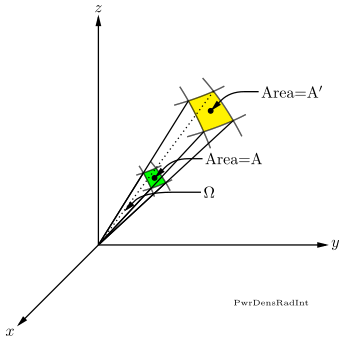
| Figure 8: Constant power in a solid angle produces
diminishing Power Densityi (1/r2). |

| Figure 12: Reciprocity concepts |

| Figure 13: Aperture Efficiency of a Parabolic Dish |

| Figure 14: Effective Aperture of Dipole ≫ Physical Aperture |

| Figure 15: Apertures MUST NOT overlap! |

| Figure 16: Radiation Resistance concept. |

| Figure 17: Wheeler cap method of determining Rloss |

| Figure 18: Terminal impedance as a Tx and Rx |

| Figure 19: Point-to-point Link parameters |

| Figure 20: Amplitude Modulation |

| Figure 21: AM Demodulation |

| Figure 22: Double Side-band Large Carrier |

| Figure 23: Frequency Modulation |

| Figure 24: Amplitude, Frequency and Phase Shift Keying |

| Figure 25: Bit error rates at Signal to Noise Levels. |

| Figure 26: Two types of 16-ary Phase and Level shifted constellations. |

| Figure 27: Binary Phase Shift Keying |

| Figure 28: Quadrature Phase shift Keying |

| Figure 29: π/4 Differential Quadrature Phase Shift Keying |

| Figure 30: Offset Quadrature Phase Shift Keying |

| Figure 31: Minimum Shift Keying |

| Figure 32: Frequency Division Multiple Access |

| Figure 33: Time Division Multiple Access |

| Figure 34: Code Division Multiple Access Spreads the Spectrum. |

| Figure 35: Space Division Multiple Access with “Smart” antennas. |

| Figure 36: Fading due to Multipath Cancellation |

| Figure 37: Bit Error Rate increases with decreasing S/N ratio. |
Chapter 2 examples
Back to Circuit macros
Back to my Home Page
This document was translated from LATEX by
HEVEA.